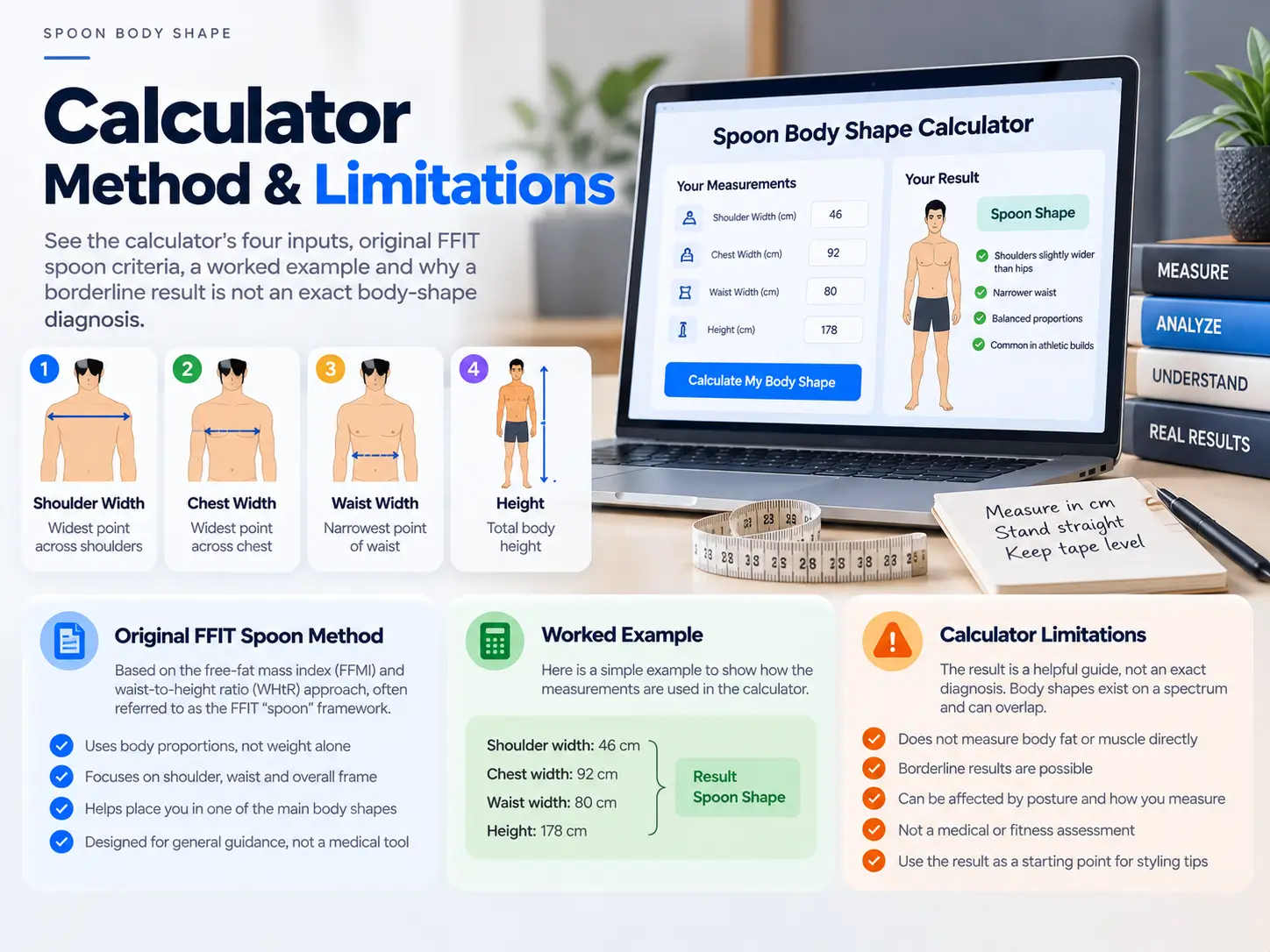
How the Spoon Body Shape Calculator Works
The short answerThe calculator checks whether four measurements meet one published set of spoon criteria. It does not classify every possible body shape.
The four inputs
Enter bust, waist, high-hip and full-hip circumferences. Circumference means the distance all the way around, not the width seen in a front-facing photograph. Use one unit for every field. Centimeters are converted to inches by dividing by 2.54.
See how to take the measurements before entering them. Inconsistent tape placement can change a result.
The rule used
The tool applies the original spoon row reproduced in Table 7 of Sokolowski and Bettencourt (2020), FFIT formulas and their limitations (PDF). All three conditions must be true:
- Full hip minus bust is greater than 2 inches.
- Full hip minus waist is at least 7 inches.
- High hip divided by waist is at least 1.193.
This implementation checks that row in isolation. It does not run the full FFIT classification system, and it does not use the paper’s modified formula set.
A worked example
These are invented measurements for explaining the calculation: bust 34 in, waist 27 in, high hip 33 in and full hip 39 in.
- 39 − 34 = 5: greater than 2.
- 39 − 27 = 12: at least 7.
- 33 ÷ 27 ≈ 1.222: at least 1.193.
All three conditions pass. The result means these numbers meet the selected spoon criteria. It does not mean a particular dress size or jean cut will fit.
What “borderline” means
The website adds a sensitivity check around the entered values: it varies each measurement by a quarter of an inch and checks the combinations. If some combinations pass and others fail, the result is marked borderline. Combinations where high hip exceeds full hip are skipped.
The quarter-inch range is a website design choice to illustrate sensitivity. It is not a measured error rate or a validated confidence interval. Remeasure consistently rather than changing your numbers to reach a preferred label.
What this result cannot tell you
A non-match does not automatically mean pear, hourglass or another shape. Measurements can fit overlapping descriptions or none of a system’s categories. The cited paper itself discusses classification limitations and proposed changes for plus-size bodies.
The tool cannot diagnose health conditions, infer bone structure or identify body composition. It is also not a clothing-size predictor: garment ease, fabric, rise and brand patterns all affect fit.
The calculator code uses numeric inputs in the browser. The broader website’s privacy practices are separate; read the privacy policy.
Use the result for a practical next step
If your goal is choosing clothes, move to the outfit and fit guide. If two websites give different labels, use the spoon versus pear comparison to understand why.
Source and further reading
University of Oregon: Sokolowski and Bettencourt’s FFIT paper (PDF). The calculator method draws on the original spoon criteria reproduced in Table 7. Clothing suggestions on this site are practical editorial options, not findings tested by that paper.
4 thoughts on “Spoon Body Shape Calculator Method & Limitations”