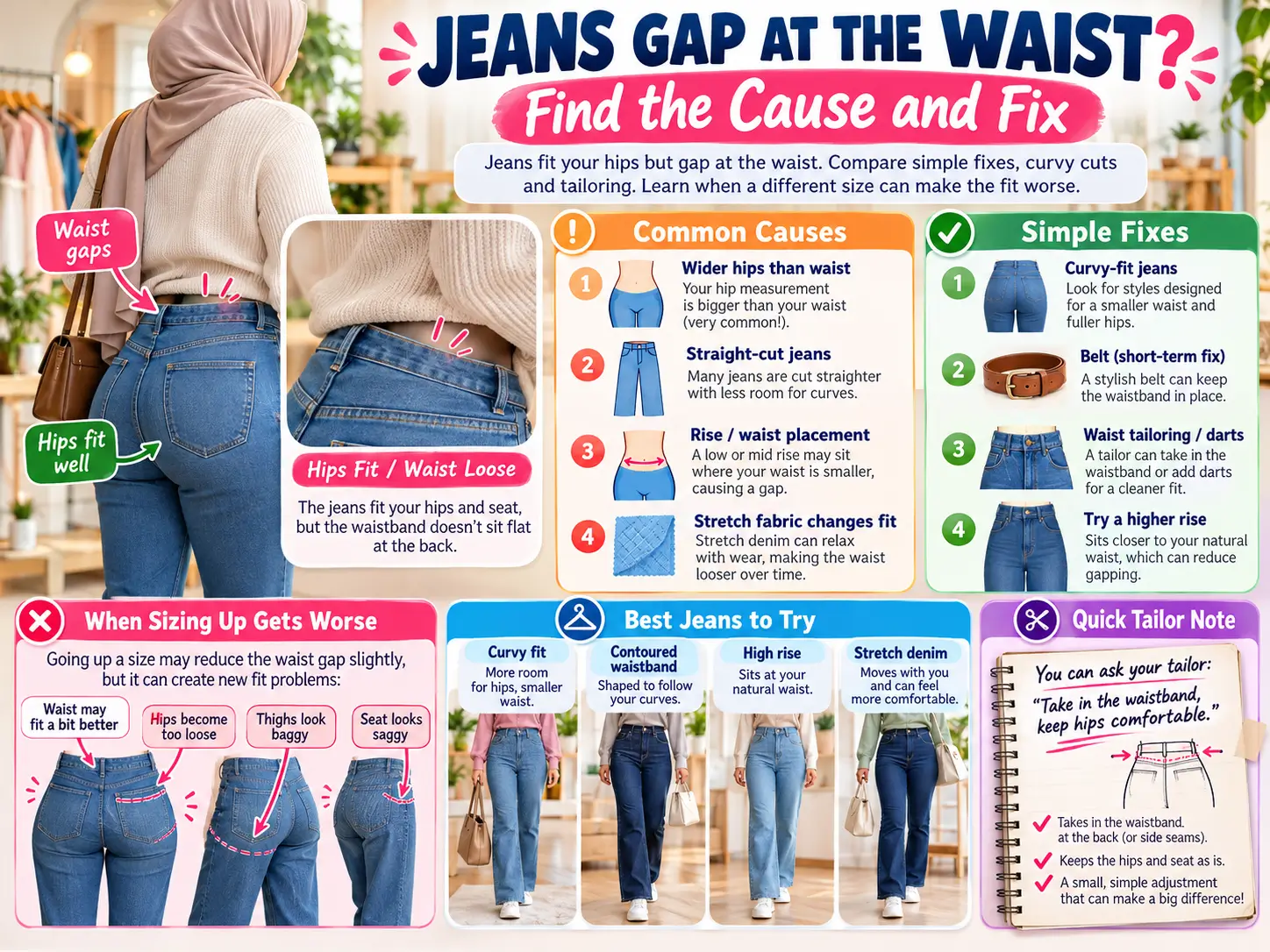
Jeans Gap at the Waist? Find the Cause and Fix
The short answerIf your jeans fit your hips but leave a gap at the waist, the cut may not match your proportions. First check where they feel loose or tight. Then compare a different waistband or fit before buying a smaller size.
Is the problem the size or the cut?
A smaller pair gets smaller in more places than the waist. That can help if the whole pair is loose. It may make things worse if your hips or thighs already feel tight.
Try the jeans without a belt. Stand, sit and take a few steps. Notice whether the waistband gaps all around or only at the back. Also check if the jeans slide down, twist or pull across the hips.
| What you notice | What to compare next |
|---|---|
| Waist, hips and thighs all feel loose | Try the next size down, then repeat the sitting check. |
| Waist gaps, but hips feel comfortable | Compare a curvy cut or a more shaped waistband. |
| Waist gaps and hips feel tight | Look for more hip room with a smaller waist; do not simply size down. |
| Fit feels good at first, then becomes loose | Compare the fabric and care instructions. Ask the brand how the denim is meant to relax. |
These are starting points, not a fitting diagnosis. Several issues can happen in the same pair.
Four fixes worth comparing
1. A belt for a small amount of looseness
A belt is useful when it holds the jeans comfortably without folding the waistband into thick bunches. If you need to pull it very tight, compare another cut instead.
2. A curved or contoured waistband
“Contoured” means the band is shaped rather than cut as a straight strip. It may sit closer to your waist. The label alone is not a fit promise, so try sitting in it.
3. A curvy-fit version
Some brands change the balance between waist, hip and thigh room. For example, Levi’s describes its 501 Curve cut as having a smaller waist with fuller hips and thighs. That is a concrete example of a different cut, not a recommendation that this particular pair will fit you. We have not tested it.
4. A different rise
Rise affects where the waistband sits. A high-rise pair may sit near your natural waist; another pair may sit lower. Compare the position that feels comfortable on you. High rise is not automatically the answer to every waist gap.
When should you ask a tailor?
Ask before buying if the jeans fit well elsewhere and only the waistband needs work. Show the tailor how you want the jeans to sit, and ask whether the change will affect pockets, belt loops or the back seam.
There is no single safe number of inches that every pair can be taken in. Construction and the amount of change matter. Get a quote, then compare the total cost with another pair.
For readers who sew, Closet Core’s pants-fitting guide explains waistband and other pattern adjustments. Altering a sewing pattern is different from changing a finished pair of jeans.
What not to rely on
- Very hot washing as a precise fix: it is not a reliable way to shrink only the waist. Follow the garment’s care label.
- A temporary button trick as a final fit: fastening can change without solving tight hips or an uncomfortable rise.
- A body-shape label: a waist gap does not prove that you have a spoon shape.
The quick try-on check
- Fasten the jeans without pulling hard on the button.
- Sit down and check the waistband.
- Walk and bend as you normally would.
- Check whether the jeans stay in the position you want.
- Compare a different cut before deciding the problem is your body.
If your waist and hips fall into different rows on a chart, read how to choose when waist and hips need different sizes. For complete outfit ideas, use the spoon body shape outfit guide.
Do wide-leg jeans fix a waist gap?
Not necessarily. A wider leg changes the leg shape. The waist and hip cut still need to suit you.
Can I use these tips without knowing my body shape?
Yes. Work from how the jeans fit. You do not need a body-shape label to choose comfortable clothing.
1 thought on “Jeans Gap at the Waist? Find the Cause and Fix”