How to Measure Bust, Waist, High Hip and Full Hip
The short answerUse a soft tape and measure all the way around your body. Four consistent measurements are more useful than a guess from a photograph.
Before you start
You need a flexible measuring tape, a mirror and somewhere to record the results. Thin, close-fitting clothing can make tape placement easier; bulky layers change the measurement. You do not need to take or upload a photo.
Stand comfortably and breathe normally. Keep the tape flat and level, snug enough to stay in place without pressing into your body. Check your back in a mirror, or ask someone you trust to help keep the tape level. Use the same clothing and posture for repeat measurements.
If you are following a brand’s size chart, use that brand’s measuring instructions. Its landmarks may differ from a general body-shape guide.
Take these four measurements
1. Bust
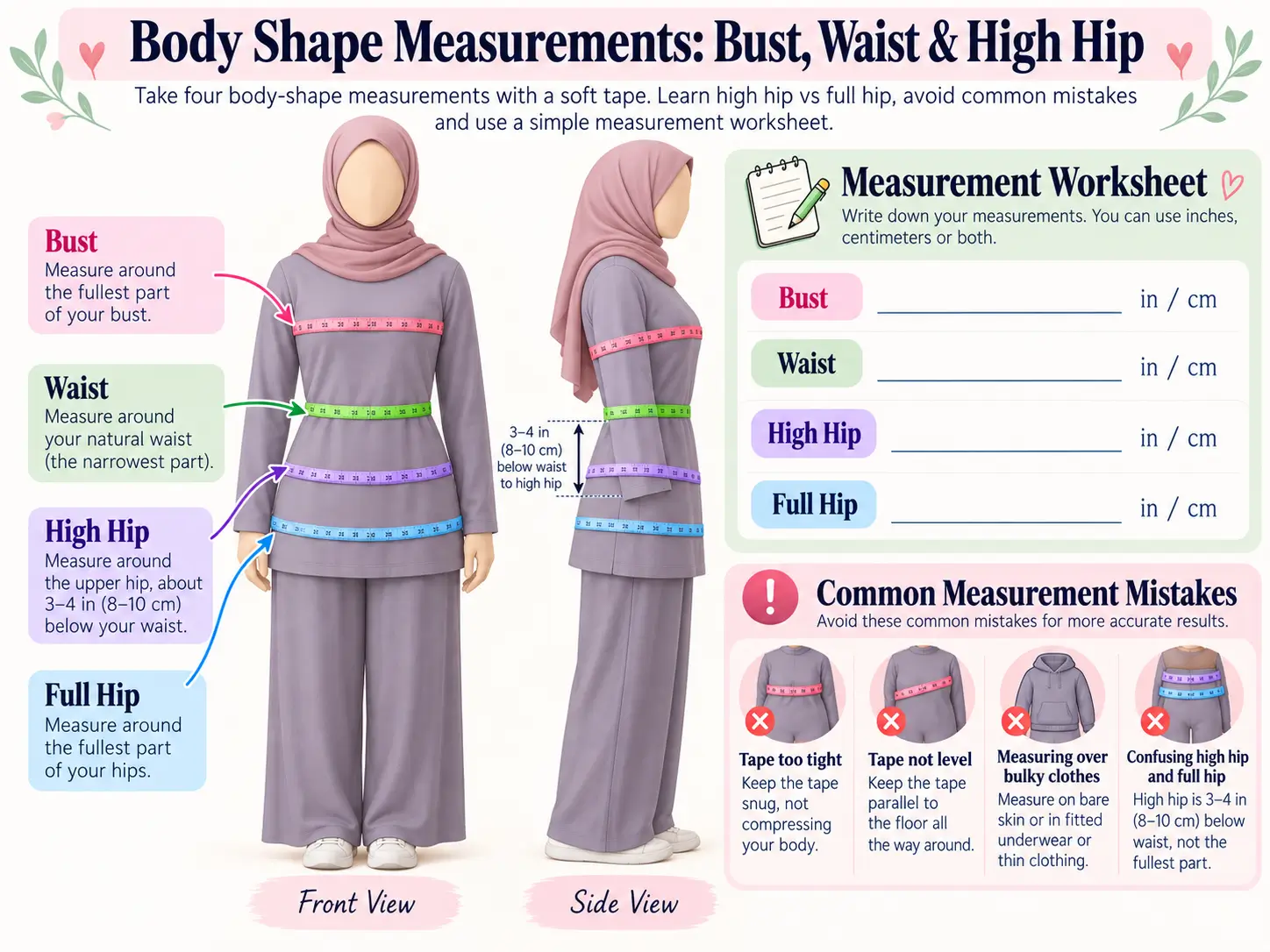
Bring the tape around the fullest part of your bust and across your back. Check that it has not slipped down behind you. Record the circumference without pulling tightly.
2. Natural waist
Measure around your natural waist, where your torso creases when you gently bend sideways. Stand upright again before reading the tape. This is not necessarily your navel or the waistband of your trousers. If the narrowest point is unclear, note the landmark you choose so you can repeat it consistently.
3. High hip
Measure around the upper hip area below your waist and above the fullest hip. About 3–4 inches (7.6–10.2 cm) below the waist is a common home-measuring starting point, but bodies differ. It is not a universal research landmark. Record how far below your waist you placed the tape and keep that location consistent.
4. Full hip
Move the tape around the fullest part of your hip and seat area. Use a mirror to keep it horizontal. Do not assume the widest point is a fixed number of inches below your waist. Record the largest circumference at the full-hip area without tilting the tape.
A simple measurement worksheet
Copy this table into a private note or print it. You do not have to email your measurements to use the tool.
| Measurement | First reading | Second reading |
|---|---|---|
| Bust | ________ | ________ |
| Waist | ________ | ________ |
| High hip | ________ | ________ |
| Full hip | ________ | ________ |
Also record: unit, date and high-hip distance below the waist. If readings differ noticeably, check tape position and take another reading. Do not choose the smallest number simply because you prefer it.
Fix common measurement mistakes
- The result changes when I repeat it: check tape height, tension and posture. You may also be close to a formula threshold.
- I only know my clothing size: sizes vary between brands and cannot replace these four measurements.
- I measured my shoulders across the front: that is a width. Do not enter it as bust circumference.
- My waist is in inches and my hips are in centimeters: convert every measurement to the same unit first. One inch equals 2.54 cm.
- I have only a rigid ruler: a non-stretch cord can help transfer a circumference to a ruler, but a flexible measuring tape is easier to position and read.
What to do with the numbers
Read the calculator’s method before treating its result as a fixed identity. Home tape measurements are not equivalent to a standardized 3D scan protocol. The method’s research background also has limits: Sokolowski and Bettencourt (2020), FFIT formulas and their limitations (PDF).
For shopping, compare your measurements with the actual brand chart and check whether it lists body or garment measurements. A garment needs room for movement; your circumference is not automatically the finished garment measurement you should buy.
Can I measure over clothes?
Yes, but thick fabric can add to the reading. Use similar thin clothing each time and follow the retailer’s instructions when choosing a size.
Do I need a body-shape label to buy clothes?
No. Your measurements, the garment size chart and a movement check are more useful than a label alone.
Source and further reading
University of Oregon: Sokolowski and Bettencourt’s FFIT paper (PDF). The calculator method draws on the original spoon criteria reproduced in Table 7. Clothing suggestions on this site are practical editorial options, not findings tested by that paper.
3 thoughts on “Body Shape Measurements: Bust, Waist & High Hip”