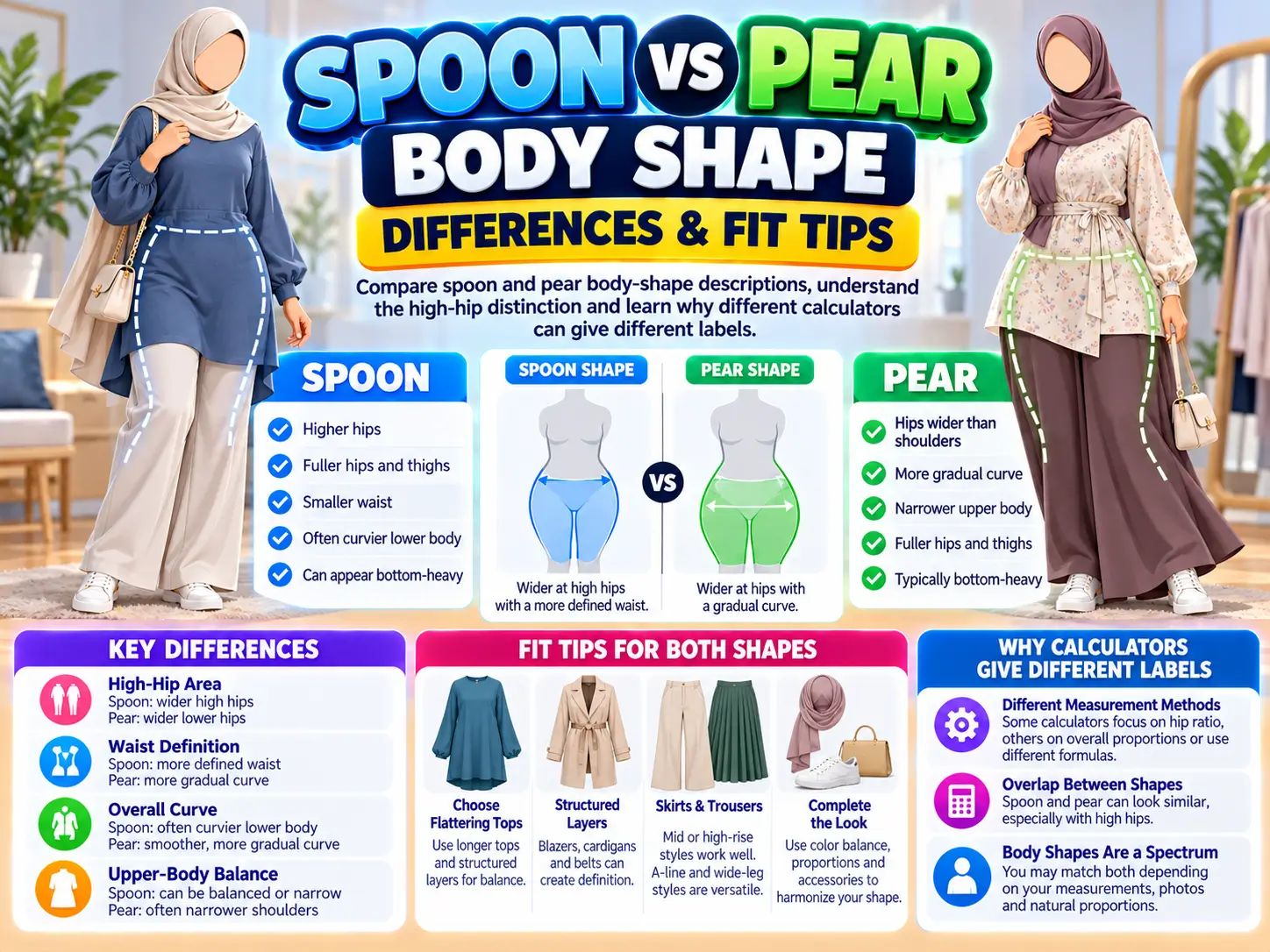
Spoon vs Pear Body Shape: What Is the Difference?
The short answerBoth terms often describe fuller hips relative to the upper body. “Spoon” usually places more emphasis on fullness high on the hip. Definitions vary between styling guides and measurement systems.
Compare the descriptions
| Question | Spoon | Pear |
|---|---|---|
| What does the term emphasize? | Fullness near the upper hip, below the waist. | A lower body that looks or measures fuller than the upper body. |
| Is high hip important? | Often part of the description; used by this site’s calculator. | Many everyday descriptions do not specify a high-hip measurement. |
| Is there one universal cutoff? | No. A specific calculator may state its own method. | No. “Pear” and “triangle” are not used consistently everywhere. |
| Can the clothing advice overlap? | Yes. Waist-to-hip fit and room to move may matter. | Yes. Many of the same fit checks are useful. |
A sharply visible “hip shelf” is not something every person must have to use a spoon styling guide. A photograph alone also cannot confirm circumference ratios.
Why the high hip gets attention
Imagine two people with similar bust, waist and full-hip measurements. The curve between waist and full hip can still differ. One may need more room near the upper hip; the other may need more room lower down. The same trousers can therefore sit differently on them.
That is the useful question behind the labels: where does a garment need space? A high-hip measurement can add information that bust, waist and full hip alone do not show. Follow the four-measurement guide if you want to compare consistently.
Why calculators disagree
Some calculators use three measurements, while others include high hip or shoulders. Some compare circumferences; visual tools may compare apparent widths. The cutoffs and the order in which categories are checked can also differ.
Our methodology states exactly which rule the homepage checks. It is an isolated spoon-criteria check, not a pear-versus-spoon diagnosis. A non-match does not prove that you are pear-shaped.
For background, Sokolowski and Bettencourt (2020), FFIT formulas and their limitations (PDF) describes an apparel classification method and changes proposed to address its limitations. Its categories should not be treated as a universal dictionary of everyday styling terms.
Use the distinction only when it helps you dress
If trousers pull across the upper hip
Try a cut with more room in that area, and compare where the waistband sits. A larger size alone may create a loose waist while leaving the underlying shape mismatch unresolved.
If the waist gaps but the hips fit
Try a contoured waistband or a curvy-fit range. Compare the actual chart: “curvy” is a retailer’s fit description, not a standardized size. A tailor can assess whether a waistband alteration is practical.
If both descriptions seem relevant
You can borrow advice from both. Keep the suggestions that make your clothes comfortable and match your preferred look. There is no need to force yourself into one category.
See outfits, jeans and dress fit tips for practical examples.
Is spoon the same as pear?
Some style guides group them together; others use spoon for more upper-hip emphasis. Check how a particular guide defines the words before comparing its advice.
Which shape is better?
Neither. These labels describe proportions for clothing discussions. They are not rankings of attractiveness or health.
Can jeans that gap at the waist prove my shape?
No. Gapping can reflect the waistband shape, garment size, fabric or rise. Use it as a clothing-fit clue, not proof of a body category.
Source and further reading
University of Oregon: Sokolowski and Bettencourt’s FFIT paper (PDF). The calculator method draws on the original spoon criteria reproduced in Table 7. Clothing suggestions on this site are practical editorial options, not findings tested by that paper.