Spoon Body Shape Outfits: Jeans, Dresses and Fit Tips
The short answerStart with the fitting problem you want to solve. Comfortable hips, a waistband that stays put and room to move matter more than following a list of “allowed” clothes.
Choose fit before the body-shape label
In styling language, spoon often describes a defined waist with fullness around the upper hip. You do not need to meet a calculator threshold to use this guide. Choose the advice that matches your clothes and preferences.
First decide what matters today: an easy work outfit, more coverage, a waist that does not gap, or freedom to sit comfortably. Then compare the garment’s cut and size chart. No single style is best for every person with similar measurements.
Jeans and trousers: solve the waist-to-hip mismatch
When the hips fit but the waist gaps
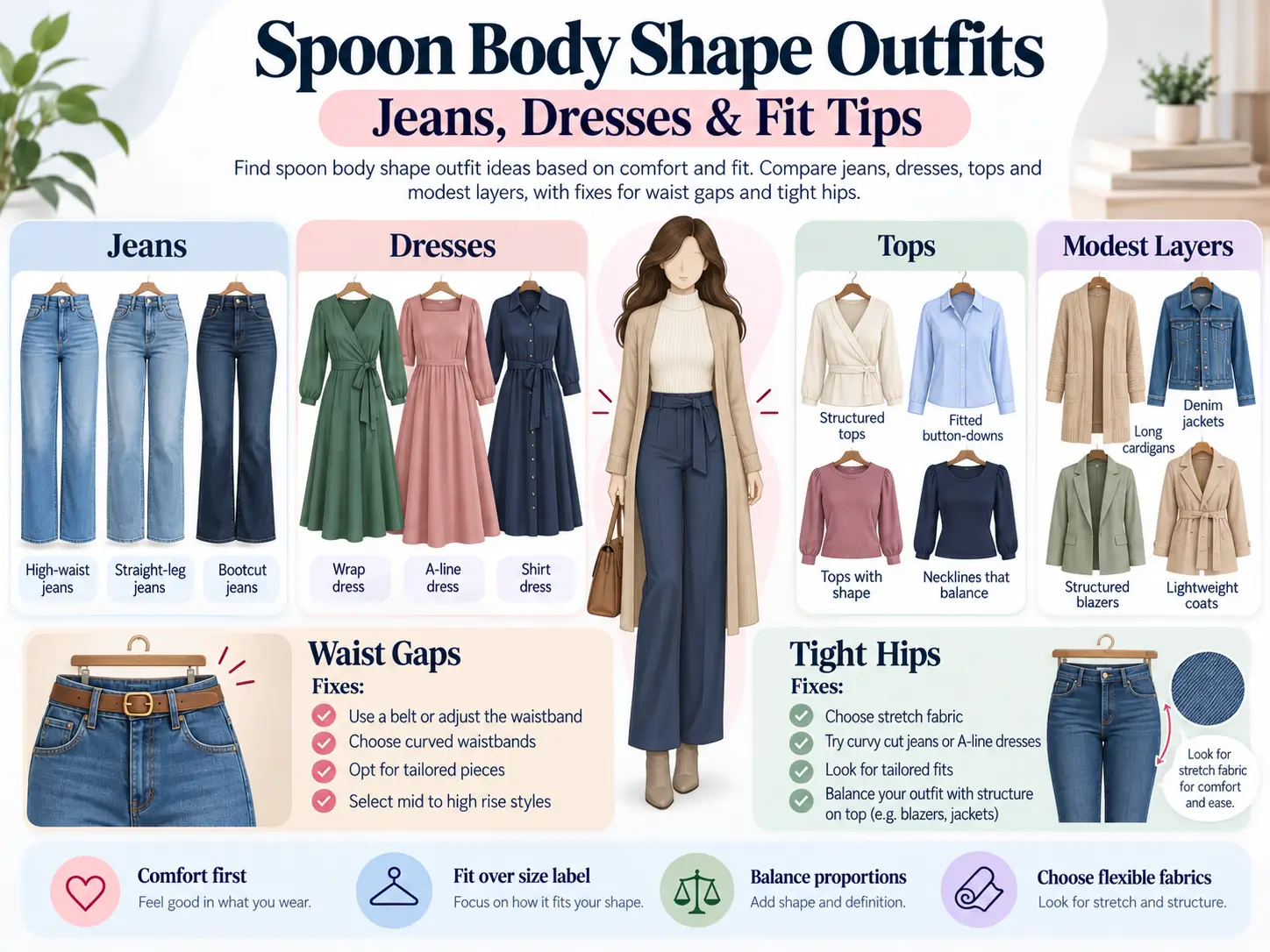
Try a contoured waistband or a curvy-fit version in the same brand. These may provide a different relationship between waist and hip room. The word “curvy” is not standardized, so use the chart and try the garment rather than assuming your usual size.
A belt can help a slightly loose waistband. If there is a large gap, tightening a belt may bunch the fabric. Ask a tailor whether taking in the waistband would affect pockets, seams or the zipper before buying a garment that needs major alteration.
Choose rise by where it sits comfortably
High-rise jeans can sit near the natural waist, but a short torso or a stiff waistband may make them uncomfortable when seated. Mid-rise is a valid option. Compare the actual rise and how the waistband sits on you; the name alone does not guarantee a position.
Choose the leg shape you like
Straight-leg, wide-leg and bootcut jeans offer different silhouettes. Start with enough room at the hip and thigh, then choose the leg opening. Skinny jeans are also an option if you like them and can move comfortably. Dark colors and flared legs are choices, not requirements.
Dresses and skirts: check where the shaping starts
A-line and fit-and-flare garments are useful starting points when you want waist definition with more room through the hips. Check where the waist seam lands; even a familiar style can pull if that seam sits too high or low for you.
A wrap dress offers some adjustability, but check neckline coverage, the overlap when you sit and whether the tie pulls at the side. A faux-wrap dress may have much less adjustment than a true wrap.
For a straighter or fitted dress, compare hip room and fabric stretch. You do not have to hide your hips or choose a flared skirt. Walk and sit in the garment, checking that it stays comfortable and does not ride up more than you want.
For skirts, try the waistband at the height you intend to wear it. A skirt that fits when lifted higher may become tight across the upper hip when worn lower.
Tops, jackets and modest layers
If a top catches at the upper hip, compare a side-slit hem, a roomier cut or a different length. A shorter top may end above that area; a longer one may need enough width to fall freely over it. Neither length is automatically better.
For shirts, check the buttons while sitting and reaching. Buy for comfortable movement rather than choosing a smaller size only to emphasize the waist. A half tuck or a belt is optional, and a relaxed untucked outfit can work well too.
For more coverage, try a longline shirt over straight trousers, a tunic with side slits, or an open lightweight layer over a comfortable base outfit. Check that the outer layer has room across the hips when closed if you plan to wear it that way.
A jacket’s shoulders, sleeves and closure all matter. A hem that ends at the fullest area is not “wrong”; choose it if you like the look and it hangs comfortably.
Four easy outfit starting points
Everyday
Straight-leg jeans, a comfortable T-shirt and trainers. Try a contoured waistband if your usual jeans gap.
Work
Trousers with enough hip room, a shirt and a jacket. Check sitting comfort and pocket openings before choosing the size.
Occasion
An A-line or fitted dress in a fabric you enjoy. Compare seam placement, coverage and movement rather than relying only on the style name.
Relaxed coverage
A side-slit tunic or longline shirt with straight trousers. Choose enough hem width for the top to fall without catching.
These are styling ideas, not tested product recommendations. Use colors, coverage and accessories that match your own taste.
A five-point fitting-room check
- Stand: does the garment hang comfortably without pulling?
- Sit: does the waistband dig in or the closure strain?
- Move: can you walk, bend and reach as needed?
- Look at the seams: do side seams twist or pockets pull open?
- Compare: does another cut solve the issue better than another size?
When buying online, read the return conditions before ordering multiple sizes. Distinguish body measurements from finished garment measurements. If you need a refresher, use the measurement guide.
Why a label cannot promise a fit
Garments differ in pattern, material and intended looseness. Two people with the same full-hip measurement may need room in different places. Research into apparel classification also discusses limitations in applying shape formulas across bodies: Sokolowski and Bettencourt (2020), FFIT formulas and their limitations (PDF). This supports caution about labels; it does not prove that one outfit style is best.
For definitions, read spoon versus pear. For the numerical check, use the calculator and its methodology.
What clothes should a spoon shape avoid?
There is no compulsory avoid list. Skip a garment if it feels uncomfortable, limits movement or does not suit your preference. The same style can fit very differently across brands.
Are high-waisted jeans always best?
No. Compare where the waistband sits and how it feels seated. Mid-rise or another cut may be more comfortable for your torso and preferences.
Source and further reading
University of Oregon: Sokolowski and Bettencourt’s FFIT paper (PDF). The calculator method draws on the original spoon criteria reproduced in Table 7. Clothing suggestions on this site are practical editorial options, not findings tested by that paper.
3 thoughts on “Spoon Body Shape Outfits: Jeans, Dresses & Fit Tips”