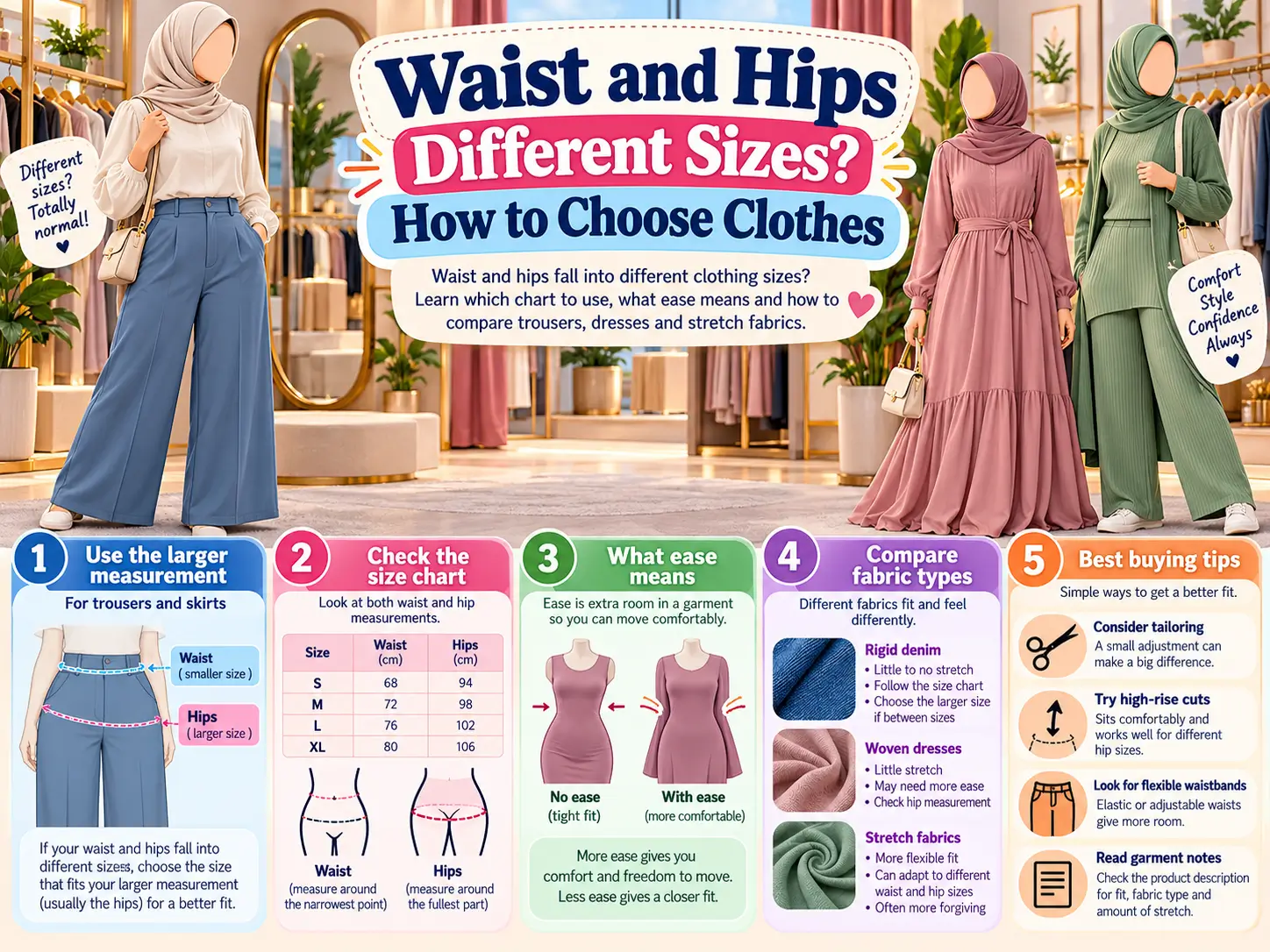
Waist and Hips Different Sizes? How to Choose Clothes
The short answerDo not average your waist size and hip size. Check the chart for that exact garment, find the area that needs room, and compare a cut that fits both measurements. For fitted bottoms, choosing only by the waist can leave too little hip room.
First, find out what the chart measures
A body chart describes the person a size is designed to fit. A garment chart describes the clothes themselves. They are not the same thing.
Read the chart heading before comparing numbers. Also check the units. A measurement of 40 centimeters is very different from 40 inches.
If the chart lists a flat waistband width, it is not yet a full circumference. Follow the seller’s method. Do not compare a flat width straight across your jeans with the distance around your body.
An easy example
This is a made-up chart for explaining the problem, not a real brand’s size chart.
| Size | Waist | Full hip |
|---|---|---|
| A | 28 | 38 |
| B | 30 | 40 |
| C | 32 | 42 |
Suppose your waist is 28 inches and your full hip is 40 inches. Your waist matches A, while your hip matches B. Picking A just because it fits your waist may leave the hips too tight. Picking B may leave a loose waist.
For fitted trousers, B is a useful starting point to try for hip room. Then compare a curvy cut, an adjustable waistband or an alteration. It is a starting point, not a guarantee: the fabric and intended fit still matter.
What does “ease” mean?
Ease is the difference between a garment’s measurement and the body measurement it is designed for. Think of it as the room built into the clothes.
For example, a non-stretch garment measuring 42 inches around the hip would have 2 inches of extra room around a 40-inch hip. This is only a math example, not a rule that every garment needs 2 inches.
Some stretch garments are designed smaller than the body and stretch when worn. This is called negative ease. Do not copy that approach for a stiff fabric.
Cashmerette’s sizing explanation shows why body and finished-garment charts are separate. Its instructions are for a specific sewing pattern, so do not transfer its fit allowance to every item you buy.
Choose by the garment you are buying
Trousers and fitted skirts
Check hip room and the waist together. If one size feels comfortable through the hips but loose at the waist, compare a different cut. A small alteration may help, but ask a tailor before assuming a large change is possible.
Dresses
Check bust, waist and hips, not only the part you usually find difficult. A loose skirt may give more hip room, while a fitted bodice still needs to fit your bust. Check where the waist seam sits too.
Stretch clothing
Read the brand’s fit notes and fabric details. “Stretch” does not tell you how much the fabric stretches or how well it returns to shape. Do not buy a painful fit and hope it will become comfortable.
Separates
A top and bottom in different sizes can be simpler than finding one dress or jumpsuit that fits every area. Matching size labels is not a goal.
A short checklist for online shopping
- Use the chart for the exact item, not a chart from another shop.
- Check whether the chart gives body or garment measurements.
- Read the fit and fabric notes.
- Compare the result with an item you already find comfortable, using the same measuring method.
- Check returns and alteration costs before buying.
If the listing is unclear, ask the seller: “My waist and hips match different sizes. Which measurement should guide this style, and can you provide the finished waist and hip measurements?”
For jeans that leave a gap, see the waist-gap troubleshooting guide. For broader clothing ideas, read the outfit guide.
Should I always choose the larger size?
No. The larger size can be a sensible starting point where you need room, but the right choice depends on the garment. Sometimes another cut works better than either size.
Does a spoon shape mean I need a particular size?
No. A shape label compares proportions. It does not replace a brand’s size chart or tell you a fixed clothing size.